
AI-Driven Product Enrichment for Magento Catalogs
E-commerce managers face a persistent dilemma when catalog scaling: raw product data from suppliers is rarely ready for the storefront. You often receive a chaotic spreadsheet containing basic names, raw SKUs, and perhaps a dimension or two. From there, your team is expected to manually map this data into Magento's complex, highly specific attribute sets.
This classical, manual copy-paste workflow is not just mind-numbingly slow; it is inherently error-prone, leading to broken faceted search filters and poor SEO. (This is one of the applied tactics in our broader pillar on how AI is transforming e-commerce.)
This post breaks down exactly where manual enrichment fails, what an AI-driven pipeline does differently, the common accuracy and SEO pitfalls, and the architecture that actually scales to tens of thousands of SKUs.
The Breakdown of Manual Data Entry
To understand the problem, look at the journey of a single product upload through a manual process:
- The Supplier Dump: A CSV arrives with a column named "Color_Code" containing cryptic values like "B", "R", "NV", "OS".
- The Translation Bottleneck: An employee must translate "Color_Code: B" into Magento's dropdown attribute "Color: Blue" — except the supplier sometimes means Black. The employee guesses, or emails the supplier, or skips the attribute entirely.
- The Attribute-Set Matching: The product's category determines which attribute set applies. Is "Electronics > Laptops" the right category? Is there a sub-category for gaming laptops? Does it have a
ram_sizeattribute, or justmemory? - The SEO Void: The supplier provided no meta-description, no SEO-friendly URL key, no alt text for images. The employee has to write these from scratch or leave them blank.
- The Description Gap: The supplier provided three bullet points. The storefront needs 150-300 words of prose. That's 2,000 SKUs × 10 minutes per description = 300+ hours of copywriting.
When scaled across 10,000 SKUs, this administrative overhead doesn't just slow you down — it strangles your time-to-market. New product lines that should launch in a week take two months. Seasonal catalog refreshes get postponed. Suppliers update their CSVs and your catalog never catches up.
What AI-Driven Enrichment Actually Does
The solution lies in shifting from manual data entry to AI-Driven Data Enrichment. Modern technical setups leverage Large Language Models to sit between your raw data and your Magento database. In a well-designed pipeline, an LLM handles four distinct tasks:
1. Attribute extraction
Instead of writing complex Excel VLOOKUPs or regex patterns, an AI mapping engine conceptually understands your data. When it sees an entry for "15-inch gaming laptop 16GB", the AI autonomously parses the attributes — it knows to map "16GB" to the ram_size attribute and "15-inch" to the screen_size attribute within Magento, outputting a structured dataset ready for direct import.
This works even on messy supplier data. "Blk" becomes "Black". "med" becomes "Medium". "Assorted" becomes a multi-select covering the known variants. The AI applies context that rule-based mappers cannot.
2. Category and attribute-set assignment
Given a product name and specs, the AI can match the product to the correct Magento category tree and the correct attribute set. "iPhone 15 Pro case" goes under Electronics > Phone Accessories > Cases, with the phone_case attribute set that includes phone_model, material, and drop_rating. Manual category assignment is one of the most time-consuming parts of enrichment; AI handles it in milliseconds per SKU.
3. Description generation
The AI can autonomously write engaging, keyword-rich product descriptions based on nothing but the product's title and a bullet point of specs. Given the right prompt and brand voice examples, output quality is good enough to ship as-is for the long tail of SKUs and as a first draft for hero products.
The key to description quality is constraint: tell the AI the exact length, keyword targets, brand tone, and structural requirements. Unconstrained AI descriptions are generic; constrained ones are surprisingly good.
4. SEO metadata
Meta title, meta description, URL key, H1, image alt text — the AI generates all of these from the enriched product data. Done properly, this produces cleaner SEO metadata than most manual processes because the AI is consistent about length limits, keyword placement, and readability scoring.
Architecture: The Google Sheets + Apps Script Pattern
Managing this AI process doesn't require a $10,000/month Product Information Management (PIM) system. A surprisingly robust architecture uses tools most stores already have:
- Google Sheets as staging: Supplier CSV lands in a "Raw Data" tab. Each row is an unenriched product.
- Apps Script as orchestration: A custom menu triggers "Enrich Selected Rows" which sends batches to the AI provider (OpenAI, Anthropic, or Google) via
UrlFetchApp. - Structured outputs: The AI returns JSON with extracted attributes, category, description, and SEO metadata. Apps Script writes these into separate columns in an "Enriched" tab.
- Human review: A merchandising lead reviews the enriched rows, flags any bad outputs for re-enrichment, and approves the batch.
- Magento sync: Approved rows push to Magento via the REST or GraphQL API — the same pattern we cover in our Magento 2 order sync pillar.
This architecture is powerful because it keeps humans in the loop visually, in a tool they already know, while automating the tedious part. The Sheet becomes the source of truth; Magento becomes the display layer.
The Accuracy Question
The single most common objection to AI enrichment is: "won't it make mistakes?" Yes, it will. The question is whether it makes fewer mistakes than a tired human at 3pm, and whether you have a review process to catch them.
Expected accuracy on current flagship models (GPT-4o, Claude Sonnet, Gemini Pro):
- Structured attribute extraction (clean supplier data): 92-97%
- Structured attribute extraction (messy supplier data): 80-90%
- Category assignment: 88-95%
- Description generation (with constraints): subjective, but roughly equivalent to a competent junior copywriter
- SEO metadata: 90-95% (length, keyword placement, formatting)
These numbers are better than or competitive with manual data entry at scale, especially because humans also make mistakes and fatigue degrades human output faster than it degrades LLM output.
The right workflow is: AI does the bulk pass, a reviewer approves or corrects a sampled 5-10% of outputs, and the correction signal feeds back into the prompt or attribute mapping rules for the next batch.
SEO Considerations
Two concerns come up constantly: will AI-generated content get us Google-penalized, and will it hurt our rankings?
On penalties: Google's spam policy penalizes content produced "at scale without adding value". It does not penalize AI-assisted content that is accurate, specific, and useful. The safe pattern is AI drafts, humans review, and you enforce minimum quality rules (unique selling points, specific product details, factual accuracy, brand voice).
On rankings: Stores that move from no-description or thin-description SKUs to well-enriched AI-assisted descriptions see SEO traffic rise, often significantly. The reason is simple — Google needs content to rank, and enriched product pages provide it. The stores that get burned are those who deploy unreviewed AI slop at 100,000-SKU scale.
Common Pitfalls
- No human review loop. Skipping review is where AI enrichment goes wrong. The cost of review is small; the cost of publishing bad data is large.
- Wrong model for the job. Using the cheapest model for description writing produces generic copy. Using the flagship model for simple attribute classification wastes budget. Route per task.
- Insufficient prompt constraint. Unconstrained prompts produce inconsistent output. Specify length, format, tone, keywords, and structural requirements explicitly.
- Enriching before cleaning source data. If supplier data is inconsistent or contradictory, clean it first. AI amplifies input quality — garbage in means confidently-wrong garbage out.
Getting Started
Managing this AI process doesn't require a $10,000/month Product Information Management (PIM) system. Our Magento AI Product Manager integrates this exact AI-mapping capability directly into Google Sheets.
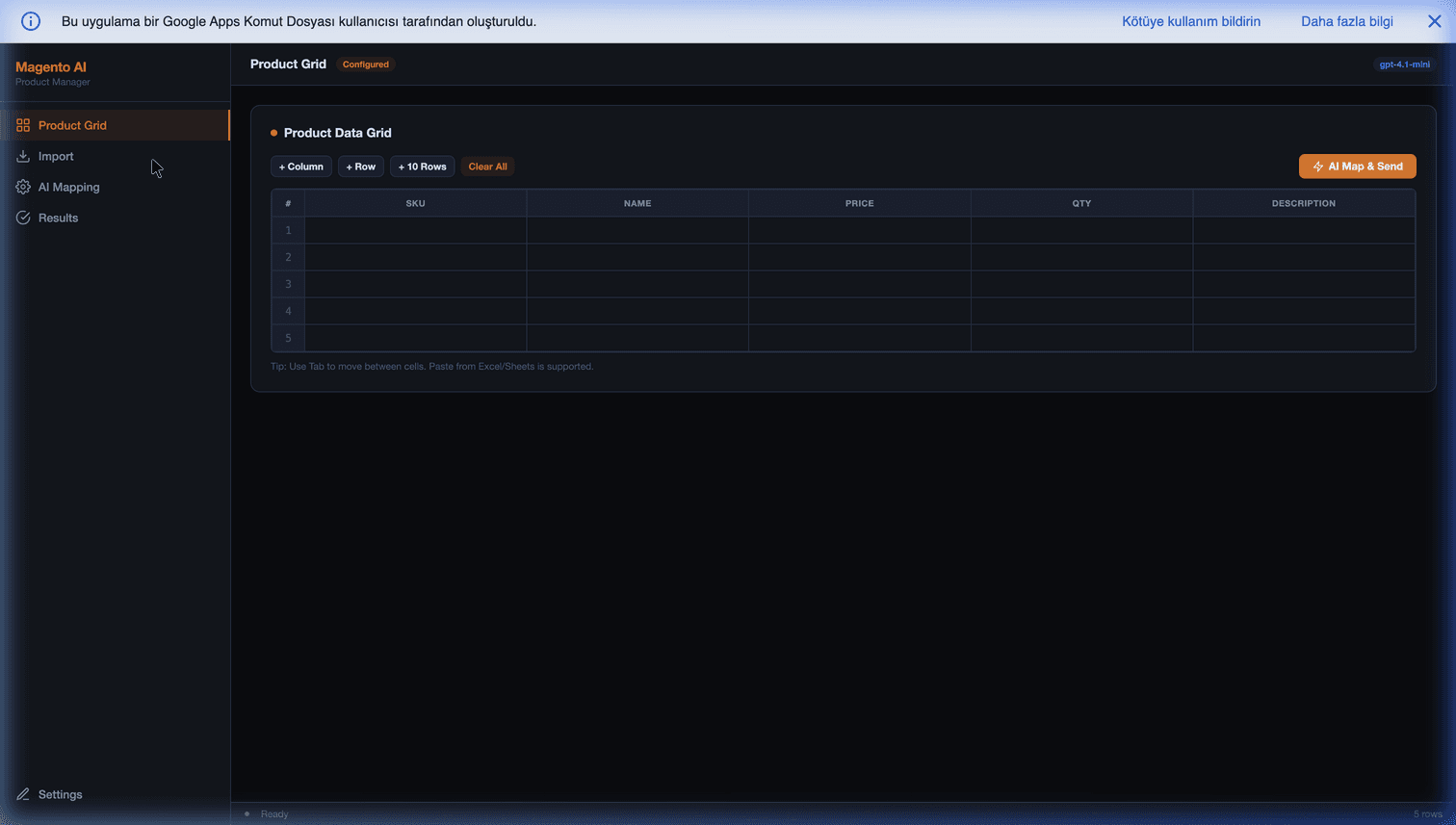
Through a dynamic spreadsheet interface, e-commerce teams can view raw imports, let the AI automatically generate attributes and descriptions, apply human-in-the-loop validation, and instantly synchronize the enriched catalog directly to their Magento storefront.
By applying AI to the mundane aspects of catalog management, you free your merchandising team to focus on what actually drives revenue: strategy, pricing, and curation.
Further Reading
- How AI is transforming e-commerce — the full pillar context.
- 5 ways AI increases e-commerce conversion rates — the demand-side complement to supply-side enrichment.
- How to add AI chat to your Magento 2 store — why catalog enrichment is a prerequisite for good chat grounding.
- Magento AI chatbot vs live chat — downstream customer-facing deployment.
- Magento 2 order sync with Google Sheets — the API-integration pattern the enrichment pipeline builds on.
Frequently Asked Questions
How much time does AI enrichment actually save on a 10,000-SKU catalog?
In the enrichment projects we've run, AI-assisted enrichment brings a full 10,000-SKU catalog from raw supplier CSV to storefront-ready in 2-4 days, versus 6-10 weeks for a 2-3 person team doing it manually. The cost per SKU drops from roughly $2-$5 in fully-loaded labor to $0.02-$0.10 in LLM API usage. The gap widens further on re-enrichment cycles (supplier updates, seasonal changes) because the AI can re-run the entire pipeline overnight.
What about accuracy — won't the AI make wrong attribute assignments?
On structured attributes (size, color, material, dimensions, weight, compatibility), current flagship LLMs get 92-97% accuracy on clean supplier data, which is similar to or slightly better than human data-entry staff. On messy data (abbreviated or inconsistent supplier columns), accuracy drops to 80-90%, which is where human-in-the-loop review matters. The right pattern is: AI does the bulk pass, a reviewer approves or corrects a sampled 5-10% of outputs, and the correction signal feeds back into the prompt for the next batch.
Can I run AI enrichment without touching my Magento backend at all?
Yes. The common architecture is: supplier CSV → Google Sheet → AI enrichment in Apps Script → push to Magento via REST/GraphQL API. You never touch Magento directly during enrichment — the Sheet is the staging area and the API call is the deploy. This also means merchandising teams can review enriched products in the Sheet before anything goes live. See our post on [Magento 2 order sync with Google Sheets](/blog/magento-2-order-sync-google-sheets) for the API-integration pattern this builds on.
Which LLM should I use for catalog enrichment — and does it matter?
For structured attribute extraction and description writing, GPT-4o, Claude Sonnet, and Gemini Pro are roughly interchangeable on quality. Use the cheapest of the three at volume (currently Gemini or GPT-4o-mini for classification, flagship model only for description writing). For multilingual catalogs, Gemini has the broadest language coverage out of the box. Avoid the smallest models (GPT-4o-mini, Haiku) for the description-writing step — they tend to produce generic, low-CTR copy.
What about SEO — will AI-generated product descriptions hurt my rankings?
Only if you deploy thin, low-effort AI output at scale without review. Google's spam policy penalizes content produced 'at scale without adding value'; it does not penalize AI-assisted content that is accurate, specific, and useful. The safe pattern is: AI drafts, humans review outputs for accuracy and brand voice, and you enforce minimum content quality rules (length, specificity, unique selling point per product). Stores that follow this pattern see SEO traffic rise after enrichment, not fall.