Magento Live Chat vs AI Chatbot: Which Cuts Support Costs More? (2026)
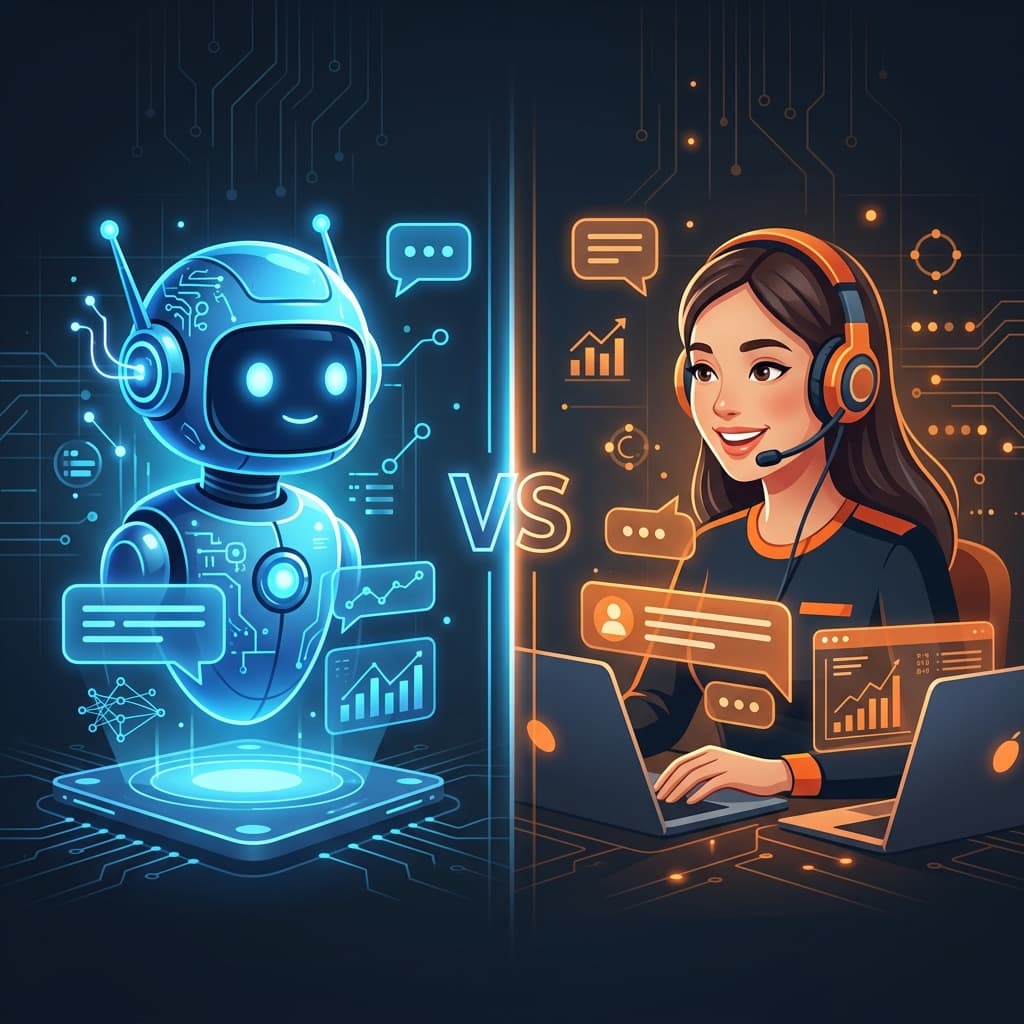
The debate between AI chatbots and traditional live chat isn't about one being universally better — it's about understanding what each does well and choosing the right fit for your store. (For the bigger picture of how AI is transforming e-commerce, see our pillar guide.)
In production Magento deployments we've seen, the answer is almost never "AI only" or "humans only" — it's a carefully tuned hybrid. This post breaks down when each wins, the common deployment pitfalls, and the hybrid architecture that usually outperforms either extreme.
The Quick Comparison
| Factor | AI Chatbot | Live Chat |
|---|---|---|
| Availability | 24/7, always on | Limited to agent hours |
| Cost per conversation | ~$0.01-0.05 | ~$5-15 per interaction |
| Scalability | Unlimited concurrent | Limited by headcount |
| Personalization | Learns from data | Depends on agent skill |
| Complex issues | May struggle | Excels here |
| Setup time | Minutes to hours | Days to weeks (hiring, training) |
Where AI Chatbots Win
1. After-hours coverage
Roughly 60% of online shopping happens outside standard business hours. An AI chatbot means you never miss a sale because no human was available to answer "Does this come in blue?" at 11pm on a Sunday. For stores serving multiple time zones, AI is the only realistic path to 24/7 first-response without a follow-the-sun support team.
2. Repetitive, catalog-grounded questions
"What's your return policy?" "Do you ship to Germany?" "Is this compatible with Magento 2.4.7?" "Is this in stock in size medium?" These questions don't need a human. They need an instant, accurate response grounded in your catalog and policies. An AI chatbot answers them consistently every time, at every hour, in every language you support.
3. Product discovery
Modern AI chatbots don't just answer questions — they actively help customers find products. "I need a gift for a tech-savvy teenager under $50" is a query that traditional keyword search handles terribly and a grounded conversational assistant handles elegantly. This is where AI contributes directly to conversion rate, not just cost reduction. See our post on 5 ways AI increases e-commerce conversion rates for the full tactical breakdown.
4. Cost at scale
If you get 1,000 customer inquiries per month, live chat could cost $5,000-15,000 in agent salaries (fully loaded). An AI chatbot handles the same volume for under $50 in API costs. The gap widens at 10,000 or 100,000 inquiries — AI cost scales near-linearly and remains cheap, while live-chat cost scales faster than linearly because team management overhead grows with headcount.
5. Consistency
Human agents have good days and bad days. An AI assistant gives every customer the same brand-appropriate response, the same product knowledge, and the same tone. That consistency is invisible when it works and extremely expensive when it breaks — and AI breaks consistency far less often than human rotations do.
Where Live Chat Still Wins
1. Complex complaints and recovery moments
Angry customers with multi-order issues, damaged shipments, or billing disputes need empathy and creative problem-solving that AI still can't fully replicate. These are also the moments where customer-lifetime-value is most at risk — resolving them well builds loyalty, resolving them poorly ends the relationship. Route them to humans.
2. High-value sales conversations
Enterprise B2B deals worth $50,000+ benefit from a real human who can negotiate price, understand nuance, build a multi-session relationship, and coordinate with your internal sales and ops teams. The AI can qualify and warm up these leads (which is valuable) but shouldn't be asked to close them.
3. Legal and compliance issues
Anything involving refund disputes, warranty claims, regulatory compliance (GDPR, CCPA, CPSC recalls) should involve a human decision-maker with clear authority to make commitments. AI outputs on these topics are a lawsuit waiting to happen unless the escalation rules are airtight.
4. The unquantifiable "human moment"
Some customers, in some situations, just want to talk to a person — and they get measurably more loyal when they can. Denying that option (or hiding it behind 15 minutes of chatbot navigation) is short-term efficiency and long-term brand damage.
The Hybrid Approach (Best of Both)
The smartest Magento stores use both in a layered architecture:
- AI chatbot as the first line — handles 70-85% of inquiries instantly, grounded in the catalog and policy docs.
- Explicit escalation path — a visible "talk to a human" button, plus automatic escalation when the AI's confidence drops below a threshold or the customer repeats the same question twice.
- AI assists live agents — when a conversation escalates, the human agent receives the full conversation transcript, a suggested response draft, and quick-access links to relevant product pages and order history. This cuts human handle-time by roughly half.
- Feedback loop — flagged conversations (negative feedback, abandoned after escalation, CSAT < 3) feed back into prompt tuning and catalog enrichment weekly.
This hybrid model gives you 24/7 coverage at a fraction of the cost, while ensuring complex issues get human attention — and the humans get AI leverage on each case they handle.
Common Deployment Pitfalls
Three failure modes kill more chatbot rollouts than anything else:
- Deploying without catalog grounding. If the AI doesn't know your products, it hallucinates or constantly says "I don't have that information." Fix the catalog first. Our post on AI-driven product enrichment for Magento catalogs covers the enrichment side.
- Hiding the human escape hatch. If customers can't clearly see how to reach a person, they bail — and some complain publicly. Always make escalation one click away.
- Firing the support team on day one. AI handles volume; the remaining cases are still high-value. Stores that cut humans too aggressively see CSAT collapse in the first month. Resize gradually based on measured escalation rate.
Making the Switch
If you're currently using live chat only, start by adding an AI chatbot alongside it — do not replace. Most customers will naturally prefer the instant AI response for simple questions, gradually reducing your live chat volume over 4-8 weeks. Then resize the live chat team to match the new escalation volume (usually 30-50% of what it was).
If you're starting from zero and running a small Magento store, the AI chatbot alone is a defensible first step — just make sure you have a human email or phone contact clearly listed so edge cases don't dead-end.
Our Magento AI Product Manager handles the catalog-ingestion side of this, ensuring the AI has clean, complete data to ground on.
Further Reading
- How AI is transforming e-commerce — the full pillar context.
- How to add AI chat to your Magento 2 store — the step-by-step installation path.
- 5 ways AI increases e-commerce conversion rates — the conversion side of AI deployment.
- AI-driven product enrichment for Magento catalogs — fixing the data-quality bottleneck before chatbot deployment.
- Voice commerce in 2026 — what comes after text chat.
Frequently Asked Questions
Is an AI chatbot actually cheaper than live chat once you factor in setup and tuning?
Yes, almost always — but not in the first month. Day-one cost of an AI chatbot is roughly $0.01-$0.05 per conversation in API usage versus $5-$15 per interaction for live chat. The caveat is the first 2-4 weeks of tuning: you will need someone (usually a part-time developer + a merchandising lead) reviewing flagged conversations, adjusting prompts, and filling gaps in the catalog content that cause bad answers. Budget 20-40 hours of that work up front. After that, the AI is dramatically cheaper and stays cheaper at any scale.
What percentage of customer conversations can an AI chatbot handle without human escalation?
In production Magento stores with good catalog grounding, 70-85% of inbound conversations resolve autonomously. The biggest single variable is catalog quality — stores with incomplete product descriptions and missing attributes drop to the 50-60% range because the AI keeps saying 'I don't have that information'. Investing in catalog enrichment before deployment raises the autonomous-resolution rate more than any amount of prompt engineering.
Will customers actually use an AI chatbot, or will they demand to speak to a human?
Customers use the AI when (1) it responds in under 3 seconds, (2) answers the first question correctly, and (3) offers a visible 'talk to a human' escape hatch. If any of those fail, they bail to live chat or Google. Modern AI chatbots hit all three; old rule-based bots from 2018-2022 fail on #2, which is why the reputation of 'chatbots' is still poor. Once customers experience a modern grounded assistant, most prefer it for simple questions and reserve human contact for real problems.
Should I get rid of my live chat team entirely if I deploy an AI chatbot?
No — this is the single most expensive mistake we see stores make. AI handles volume; humans handle value. The 15-30% of cases that escalate to humans are disproportionately the high-value ones (large orders, complex complaints, enterprise B2B negotiations) where losing the customer costs far more than a support hour. Keep live chat, but resize the team to match the escalation volume (usually 30-50% of the previous headcount) and upskill them toward consultative selling and complex problem-solving.
How long does it take to deploy an AI chatbot on a Magento 2 store?
A basic grounded assistant is 1-2 developer days: install the module, connect an AI provider API key, index your catalog, and smoke-test the top 20 customer questions. Getting to production-quality (tuned prompts, escalation rules, multilingual if needed, analytics instrumentation) is 2-4 weeks of iterative work. Voice commerce, generative UI, and deep Magento admin integration extend this further — see our [installation walkthrough](/blog/how-to-add-ai-chat-to-magento) for the step-by-step path.